
Quick answer: Almost always, a thin, straight, vertical crack above a door or window frame is cosmetic, caused by normal house settling or seasonal wood movement pulling at a drywall seam. It becomes a structural concern when the crack runs diagonally, is wider than about 1/4 inch, keeps growing, or shows up alongside a sticking door, a sloped floor, or a crack visible on both sides of the wall. When it’s just cosmetic, it’s a quick drywall patch. When it’s not, it’s a structural engineer, not a handyman.
Cracks above doorways and windows have a way of showing up on a random Tuesday and immediately making you wonder if your house is falling apart. Before you panic or start pricing foundation repair, here’s the real difference between a crack that’s just cosmetic and one that means something is actually moving.
What Actually Causes Hairline Cracks Above Doors and Windows
The corners above a door or window frame are one of the weakest points in a wall. Drywall sheets get cut around these openings, which means there’s almost always a seam and a joint compound patch right at that corner, exactly where the wall sees the most stress. A few things regularly cause a crack right there:
- Normal house settling. Every house settles a little as it ages, especially in the first year or two after construction, as framing lumber dries out and the structure adjusts to its own weight.
- Seasonal wood movement. Framing expands and contracts with temperature and humidity swings throughout the year, and that small, repeated movement pulls at the drywall seam above an opening.
- Faulty or thin taping. If the original drywall tape and joint compound weren’t applied thick enough, that seam is more likely to crack first, before anywhere else in the room.
- Nail or screw pops. As framing shifts slightly, a fastener can work its way loose, creating a small crack or a raised dot in the drywall right along the seam.
None of these are drywall cracks in the sense of something being wrong with the house. They’re drywall cracks in the sense of the wall doing exactly what drywall does over time.
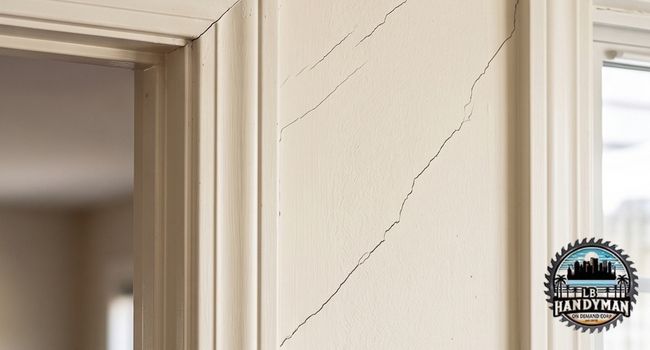
Cosmetic Crack or Structural Warning Sign?
Here’s the comparison that actually matters. If your crack lines up with the left column, it’s a drywall repair. If it lines up with the right, stop and call a structural engineer before anyone touches it with spackle. This same table applies whether it’s one crack above a single door or a pattern of cracked walls showing up in more than one room.
| Sign | Cosmetic Plaster/Drywall Crack | Structural Settlement Warning Sign |
|---|---|---|
| Direction | Straight, vertical | Diagonal (roughly 45°), horizontal, or stair-stepped |
| Width | Hairline, thinner than 1/16 to 1/8 inch | Wider than 1/4 inch, or wider at one end than the other |
| Behavior over time | Stays the same size for months or years | Visibly grows longer or wider week to week |
| Location | Just above the frame corner, on drywall only | Visible on both interior and exterior walls at the same spot |
| Other symptoms | None, the door and window still open and close normally | Door or window sticks, won’t latch, or a nearby floor feels sloped |
The single biggest tell is the diagonal crack. A crack running at an angle from the corner of a door or window frame is the most recognizable sign of differential foundation settlement, where one part of the foundation has settled more than another and is racking the wall frame out of square. If that’s what you’re looking at, this article stops being useful to you, call a structural engineer or a foundation specialist instead.
How to Fix a Cosmetic Hairline Crack
Once you’ve confirmed it’s cosmetic, the fix itself is straightforward drywall repair:
- Widen the crack slightly with a utility knife so the filler has something to actually grip, and brush away the dust.
- Apply joint compound with a taping knife, feathering it 3 to 4 inches past the edges of the crack.
- Embed a strip of joint tape over the crack for reinforcement, then apply a thin coat of compound over it.
- Let it dry fully, sand it smooth, and apply a second, wider feathered coat.
- Prime before painting. Skipping primer on a drywall patch is the most common reason a repair shows through later, called flashing, even when the patch itself was done well.
A patch done this way, with tape and two feathered coats instead of just a swipe of spackle, is a lot less likely to reappear at the first seasonal temperature swing.
What a Handyman Can Help With vs. When to Call a Structural Engineer
We’ll say this plainly instead of quoting you a drywall repair for something bigger: a handyman can fix the crack. A handyman cannot fix, diagnose, or rule out a foundation problem, and we won’t pretend otherwise just to get the job.
- Handyman-scope work: patching and repainting cosmetic hairline cracks, sheetrock repair around door and window frames, fixing nail pops, general drywall crack repair throughout a room.
- Structural-engineer territory: diagonal or stair-step cracks, cracks wider than 1/4 inch or actively growing, cracks paired with a sticking door, an uneven floor, or a crack visible on the exterior wall at the same spot.
If we come out for a crack and it looks like the second category, we’ll tell you that directly and point you toward getting a structural opinion, instead of patching over something that needs real diagnosis.
Why Long Beach Homeowners Call Us for This
Most cracks above a door or window turn out to be exactly what they look like: normal wear on a drywall seam, not a house falling apart. We’ll take a look, tell you honestly which category it’s in, and if it’s cosmetic, fix it done right the first time so it doesn’t just come back next summer. As a local, family-owned handyman in Long Beach, that’s the same drywall repair work we handle across drywall repair and installation jobs throughout the city.
Have a crack you want a second opinion on? Request a free quote, or call 562-235-9534.
FAQ
Are cracks above doors and windows always a sign of a foundation problem?
No. Most are cosmetic, caused by normal house settling or seasonal wood movement pulling at a drywall seam above the frame. It’s only a likely structural sign when the crack runs diagonally, is wider than about 1/4 inch, or keeps growing over time.
What does a diagonal crack above a door mean?
A diagonal crack running from the corner of a door or window frame is the most recognizable sign of differential foundation settlement, where one section of the foundation has settled more than another. This warrants a structural engineer, not a drywall patch.
Is it normal for a new house to have small cracks above doors?
Yes. Newly built homes commonly develop small, hairline cracks above doors and windows within the first year or two as framing lumber dries out and the house settles. These are cosmetic and expected, not a defect.
Can I just paint over a hairline crack instead of repairing it?
You can, but it usually shows through or reopens within a season. A proper repair, widening the crack, taping, and two feathered coats of joint compound before priming and painting, holds up far better than paint alone.