
Quick answer: Patching drywall after a pipe leak in Long Beach typically runs $75 to $200 for a small 6×6 inch hole, $200 to $400 for a medium access-panel-sized cut, and $400 to $900 for a larger ceiling patch, more if the ceiling has texture that needs matching. The plumber fixed the pipe. The hole they left behind is a separate job, and a separate bill.
Your plumber just left. The leak’s fixed, but there’s a hole in your wall or ceiling right where they had to cut through to reach the pipe, and now you’re wondering how much it costs to patch drywall after a pipe leak before anyone quotes you a number that feels made up. This kind of drywall hole repair is one of the most common calls we get, and the price depends almost entirely on the size of the hole you’re actually looking at.
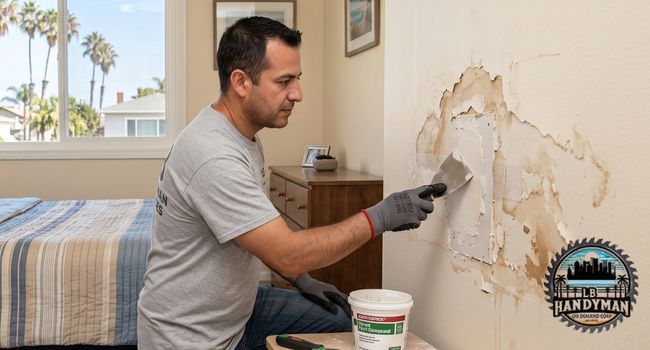
Why Your Plumber Left the Hole Open
This isn’t an oversight. A plumber’s job is the pipe, not the wall around it. Cutting drywall to reach a pipe is part of how they get to the repair, not something they’re set up to finish afterward. Most plumbers aren’t trained in drywall taping, texture matching, or paint-ready finishing, and if they did try to close it up themselves, you’d likely end up paying for a rough patch that still needs to be redone properly. On top of that, some interior walls carry a fire rating, and a quick cosmetic patch doesn’t restore that rating the way a proper repair does. Unless you specifically arranged it upfront, closing the hole is a separate job for a separate trade, and a separate bill from your plumbing invoice.
Drywall Patch Cost After a Pipe Leak: Small, Medium, and Large
The size of the hole your plumber left is the biggest factor in the price. Here’s the real breakdown, in line with what national drywall repair cost data shows by hole size:
| Patch Size | Typical Cause | Cost Range |
|---|---|---|
| Small (about 6×6 in.) | Small exploratory cut to locate or reach a pipe | $75 – $200 |
| Medium (access panel size) | Standard cut to fit tools and hands for the actual pipe repair | $200 – $400 |
| Large (ceiling patch) | A leak from above that soaked and had to remove a section of ceiling drywall | $400 – $900 |
Ceiling patches land at the higher end of that range more often than wall patches. Cutting in a flat ceiling patch takes more care to keep it level, and if your ceiling has any texture, popcorn or knockdown, matching that texture is its own separate cost, often $450 to $650 on its own for a professional job, on top of the drywall work itself.
What Actually Moves the Price Within Each Range
- Texture matching. A smooth, flat wall patch is the cheapest to blend in. Popcorn and knockdown ceiling textures cost more to match convincingly.
- Paint matching. If the paint has faded even slightly since the wall was last painted, a small patch can end up needing the whole wall repainted to avoid an obvious blotch.
- Number of coats. A properly taped patch needs at least two feathered coats of joint compound before it’s paint-ready, not one quick swipe.
- Access. A patch behind furniture, above a stairwell, or on a high ceiling takes longer, and that shows up in labor.
- How the pipe repair went. If the leak caused water damage beyond the cut itself, soaked insulation, warped drywall, or mold, that’s a bigger job than a clean patch, and it’s worth mentioning to whoever quotes you.
- Wallboard condition around the hole. If the edges crumbled during the plumber’s cut, wallboard repair may need to extend a few inches past the original hole before a clean patch is even possible.
Does Homeowners Insurance Cover This?
Often, yes, with one important condition. Insurance generally covers damage that was sudden and accidental, a pipe that burst is exactly that. A slow leak that seeped for months before anyone noticed is a different story, insurers frequently treat that as a maintenance issue and deny the claim. Either way, most policies won’t cover repairing or replacing the pipe itself, only the resulting damage to your walls, ceiling, or flooring. Report the leak to your insurer promptly, and keep photos of the hole before it’s patched, in case you need to file a claim.
What a Handyman Handles vs. What Needs the Plumber or Insurance First
We’ll close the hole your plumber left, tape it, texture-match it, paint it, done right the first time. What we won’t do is sign off on whether the underlying pipe repair was done correctly, that’s still the plumber’s call. And if there’s real water damage behind the wall, soaked insulation, mold, or structural framing that got wet, that needs to be addressed before anyone patches over it, not hidden underneath a fresh coat of paint.
- Handyman-scope work: cutting a clean patch, taping, texture matching, and painting to close up an access hole from a completed pipe repair, whether that’s a simple hole in wall repair or a full drywall replacement across a larger damaged section.
- Handle first, before patching: confirming the pipe repair is actually done and dry, drying out any soaked insulation or framing, and any mold remediation if the leak went unnoticed for a while.
Why Long Beach Homeowners Call Us for This
This is one of the most common calls we get right after a plumber leaves: a clean hole in a wall or ceiling that needs to disappear. We’ll match the texture, match the paint, and leave it looking like nothing ever happened there, not just a visible patch that ages badly. As a local, family-owned handyman in Long Beach, this sits alongside the rest of our drywall repair and installation work.
Have a hole that needs closing up? Request a free quote, or call 562-235-9534.
FAQ
How much does it cost to patch drywall after a pipe leak?
Typically $75 to $200 for a small 6×6 inch hole, $200 to $400 for a medium access-panel-sized cut, and $400 to $900 for a larger ceiling patch, more if the ceiling has texture that needs matching.
Why didn’t my plumber just patch the hole themselves?
Cutting drywall is how a plumber gets to the pipe, not something they’re set up to finish. Drywall taping, texture matching, and paint-ready finishing are a different skill set, and usually a separate job from the plumbing repair itself.
Does homeowners insurance cover drywall repair after a pipe leak?
Often yes, if the leak was sudden and accidental, like a burst pipe. A slow leak that went unnoticed for months is more likely to be treated as a maintenance issue and denied. The pipe repair itself typically isn’t covered either way, only the resulting damage.
Why does a ceiling patch cost more than a wall patch?
Ceiling patches take more care to keep level, and if the ceiling has texture like popcorn or knockdown, matching that texture convincingly is its own added cost on top of the drywall work.